Al Diaz as Interviewed by Rachel Dalamangas
AL DIAZ IS SAMO©
zingchat
New York, New York
February 2026
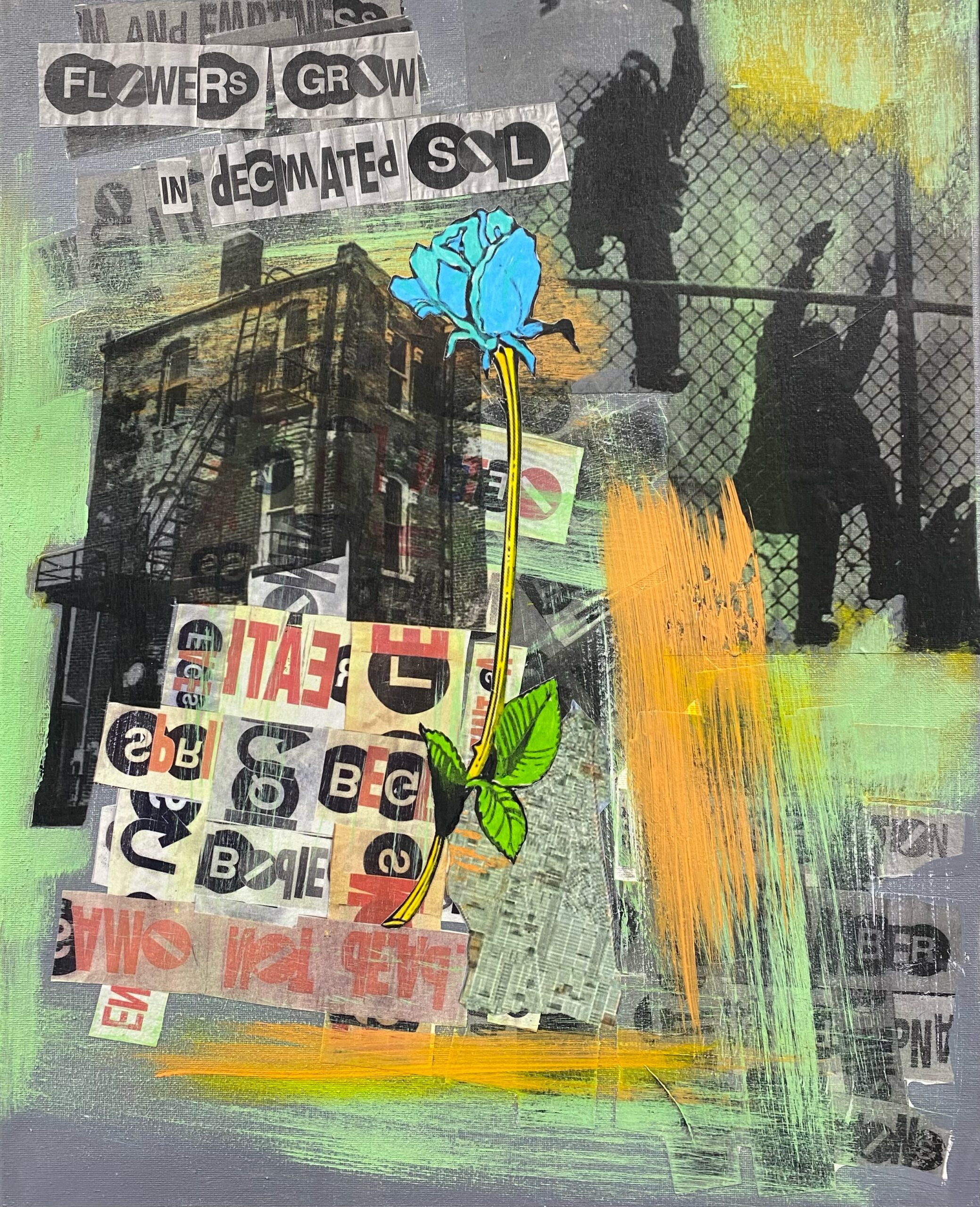
Al Diaz, Flowers Grow, 2024, mixed media on canvas
"You need to realize early on
that being an artist is not so much a career
as it is a lifestyle."
I first met Al Diaz over a decade ago when I was gathering oral histories of the 70s/80s downtown art scene. Obama was still president, and X wasn’t even yet a twinkle in Elon Musk’s eye. I wanted to ask Al about his days with his teenaged friend Jean-Michel, co-author/conspirator in the works of SAMO©, the street tag known for such pre-internet proto-memes as SAMO© . . . 4 THE SO-CALLED AVANT-GARDE and SAMO© . . . 4 MASS MEDIA MINDWASH.
Swept by the sensationalism around enfant terrible Basquiat from the lips of SoHo gallerists reading the writing on the walls of the Lower East Side, SAMO© was soon appropriated by the blue-chip gallery system it criticized, where it was rapidly becoming fashionable to stuff excess wealth with nowhere else to go into art made by those young, crowned celebrity-artists.
I was drawn, admittedly without specific aims, to this time and place in the course of interviewing artists for zing, when I noticed that among the 70s/80s downtown set—those who survived the 80s—there was a real flair for storytelling and that people from this time really were (and many of them, still are) characters, and in this way, Al is the same. He’s got the aura of someone who would be right at home in a Scorsese movie. “We weren’t ‘making street art’ we were writing graffiti,” he said when I interviewed him that first time, drawing out the words to emphasize making and art. I immediately decided I liked him and wanted to know his story, suspecting that because it wasn’t over, hadn’t really been told, it might be the more interesting one.
Frozen in time at the height of his late celebrity, Basquiat was genuinely tormented by early trauma that made the art as raw and soulful as it made the artist painfully difficult at times with those whom he called friend. These painful off-and-on friendships with other highly creative people, Al early among them, were interwoven in the creative process of art-as-lifestyle and life-as-art that made Basquiat so charismatic, painting barefoot in an Armani suit.
In January 2017, Al came over to my apartment in Ridgewood with a mutual friend, to have coffee and talk about the impending inauguration of Trump. We were talking about how the election had been basically a Twitter prank that wouldn’t end, and then Al said that he was bringing SAMO© back. Ironically, the unreleased Basquiat biopic Samo Lives, reportedly did not include the still living half of SAMO© in the process of the film’s production. Reinvigorating the same old buzz also provoked legal battles over copyright ownership in addition to threatening accuracy and preservation of the creative legacy.
In January 2026, now a full-time artist, dozens of gallery shows, two books, one arrest and a midnight sun later, looking around Al’s Sunset Park studio, the same hand that wrote SAMO© graffiti is undeniable everywhere. Distinct from the shared tag but nonetheless bluntly political and deliriously irreverent. Frenzied color and American iconography. Al is not an ‘activist’ artist but there is that quality of something insistent, urgent, and urban coming from the canvasses of recent paintings and artworks.
You’ve said you returned to an art career after Trump was elected in 2016. Your political positions have been remarkably consistent over the years. How does politics animate your work—structurally, not just thematically?
LOGIN BELOW OR SUBSCRIBE TO KEEP READING