
zingchat
THE UNSTABLE ART OF EXISTENCE WITH JANET BIGGS
In Path of Totality, on view at Cristin Tierney Gallery through October 24, 2026, Janet Biggs follows solar eclipses across time and terrain. She went to Antarctica, where fog blocked her view of the total eclipse of December 4, 2021, and to the Amazon’s headwaters in Peru, along the path of an eclipse that crossed the region in 1858. The exhibition brings together video, artifact, and a forthcoming performance on time dilation, drawing on her collaborations with scientists and dancer Vinson Fraley and on her relationship with her mother. Here, Biggs discusses astronomy and spirituality, landscape as protagonist, and why she considers none of her pieces finished.
This work approaches the Moon with both the seriousness of astronomy and the reverence of religion. How do you approach existential questions in a way that accommodates both?
My work relies on research and collaboration, especially across the sciences. I am deeply invested in questions about things unknown—to me personally, and to humanity. Many of the scientists I’ve had the honor of working with, both experimental and theoretical, speak about existential questions, about their relationships to spirituality.
For me, hard science and spirituality are entangled. Data is a language, like poetry, that is enlightening and elusive; a language that demands imagination for communication and translation. I’ve always been interested in both parallel and inverse structures: the romance of finding a connection to my mother during a total solar eclipse, and the computations of alignment and gravitational forces.
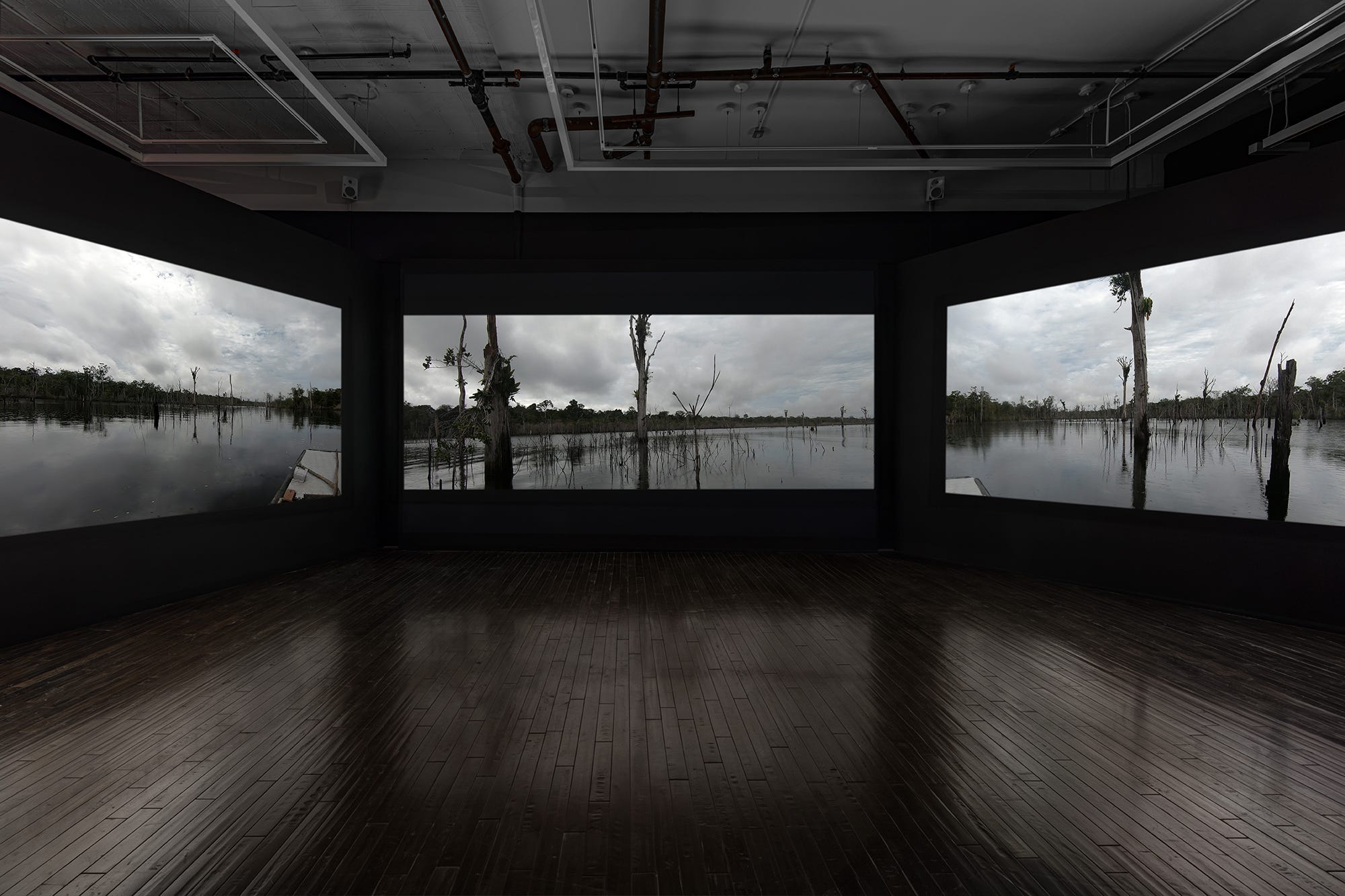
When you made “Eclipse (Antarctica, December 4, 2021)”you were unable to see the eclipse as planned and the meaning of the journey changed in artistic purpose. Is there a difference in how you approach the human subject vs landscape as subject? In a funny way there’s a kind of inversion where the human is the landscape and the landscape is the main character.
I love your read of human as landscape and landscape as the main character. I see landscapes as living entities. I remember my first time filming in Iceland, being so aware of a landscape actively re-making itself. Its immediacy shifted my thinking. I also remember a time filming inside an active volcano, as the lava roiled and folded below me, seductive with its folds and flames. It told a story of a deep past. It was one of the most complex protagonists imaginable. I had a similar experience when filming tabular icebergs moving along the horizon; their passage a story in itself.
Human as landscape is more complicated. I often mold myself to fit with other humans, much as individuals are shaped by the terrain they inhabit—not through confrontation, but as a presence that, over time, sculpts all that exists within it.
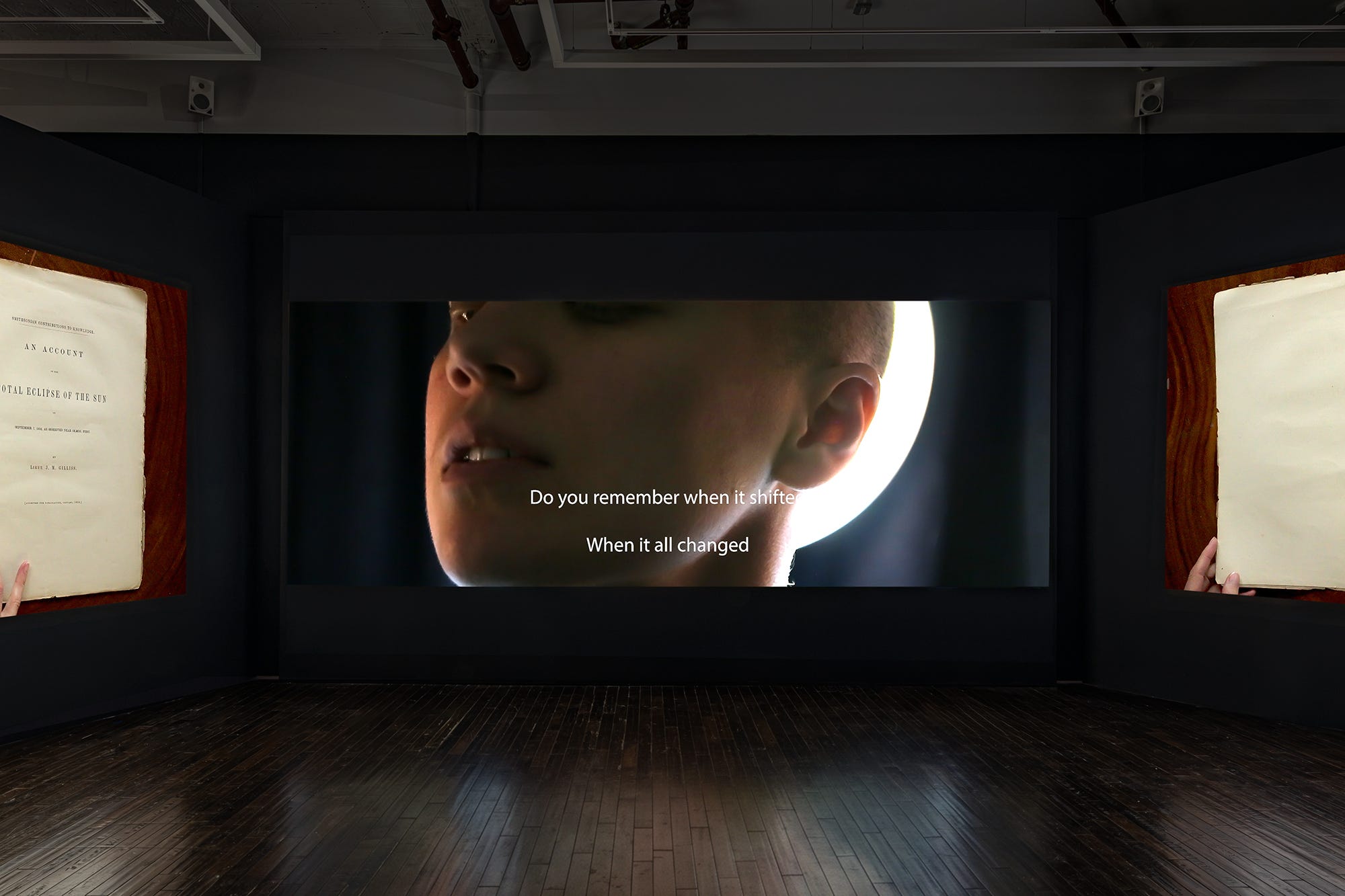
In “Eclipse (Antarctica, December 4, 2021)” the human presence is only seen from behind or to the side, evident but unrecognizable, whereas in “Eclipse (Amazon, September 7, 1858)”, the woman’s face is enlarged to exceed the limits of the screen. Her face also becomes unrecognizable, almost an alien landscape.
Landscapes and human subjects hold both awe and terror, strength and fragility.
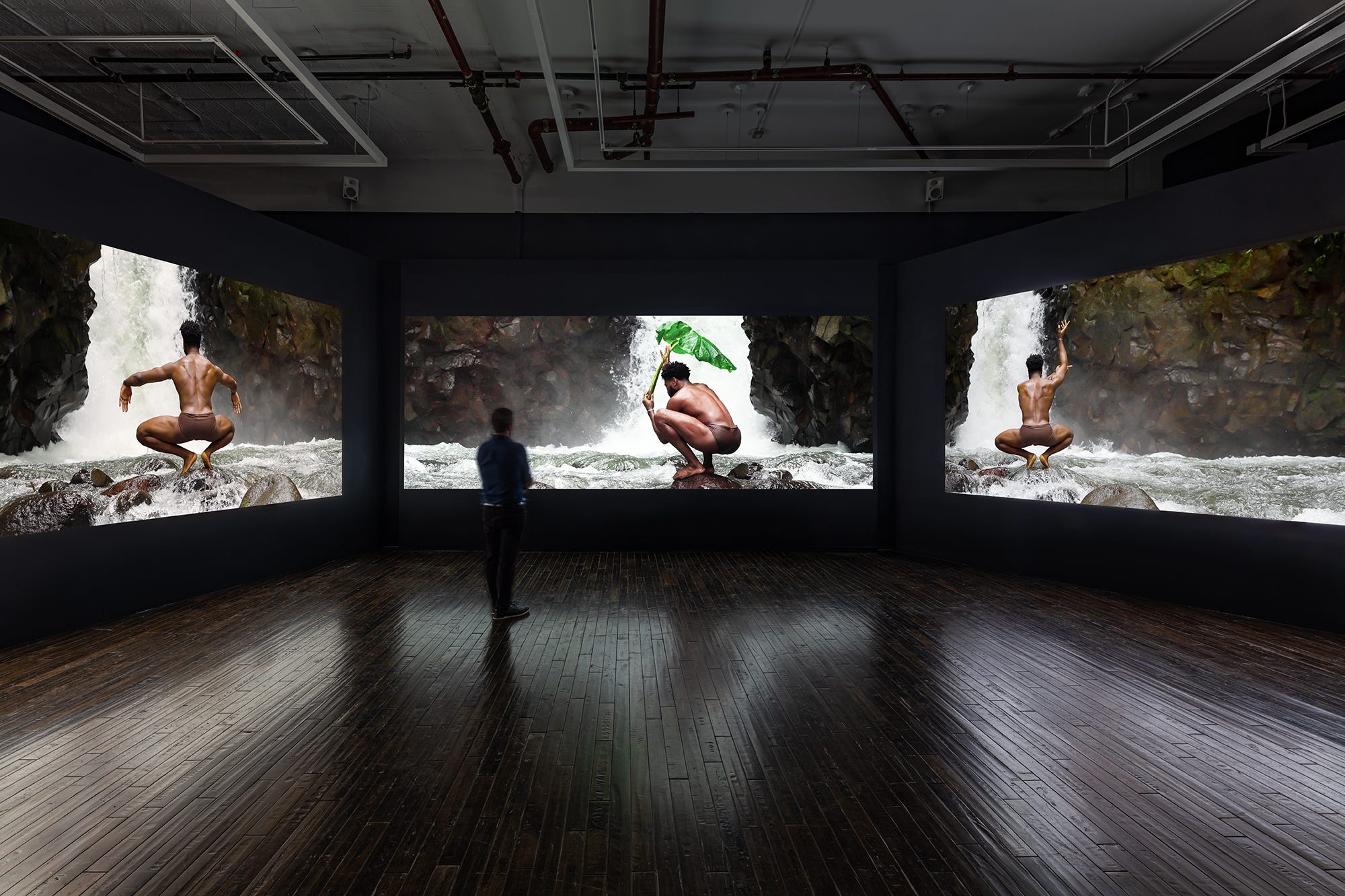
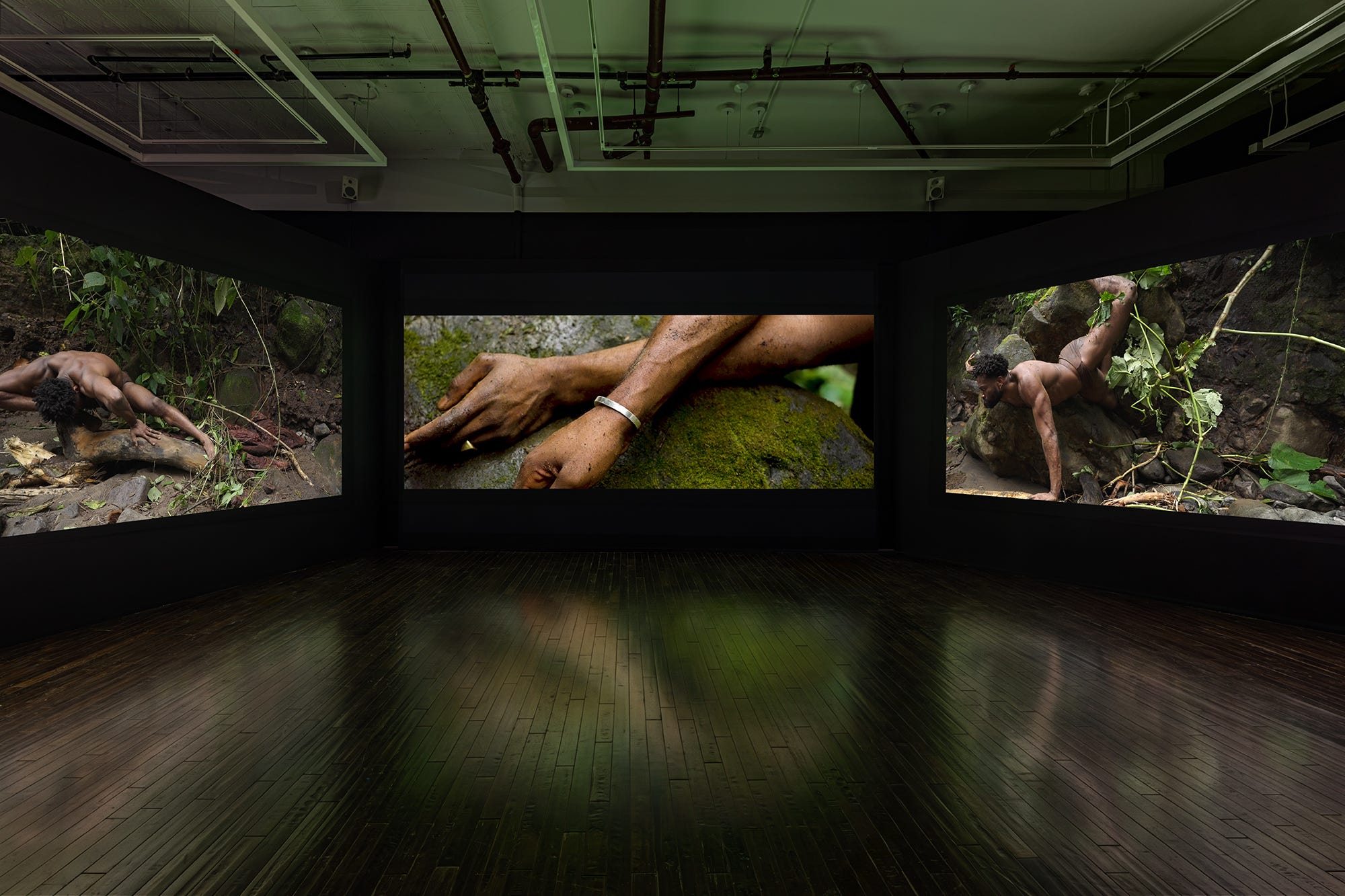
The presence of humanity in “Eclipse (Amazon, September 7, 1858)” is de-familiarizing, beautiful, and confusing. What is the man doing? Sort of this dance in the river and with a leaf?
In 2024, I traveled to the Amazon’s headwaters in Peru to film along the path of a solar eclipse that occurred in 1858. I returned to my studio and edited this footage into a single-channel piece. A year later, in 2025, I went to a dance performance by my friend Vinson Fraley. During the evening-length performance, there was a short sequence in which Vinson moved about the stage, delicately balancing a huge leaf on his hand. I watched this beautiful choreographic moment and knew that my piece was not finished.
There were many reasons for this realization. At that time, part of my research had turned to rainforests and cloud forests. I saw evidence of inverse nurturing relationships between these two ecosystems—plants in a rainforest absorbing water through their roots, while plants in a cloud forest primarily absorb moisture through their leaves. This brought to mind parent/child relationships—children being cared for by their parents, and parents eventually needing to be cared for by their children.
Vinson balancing that leaf spoke to me of humanity’s relationship to the natural world and to each other—who holds power, holds memory—personal, communal, historic — and what alternatives might look like.
In “Eclipse (Amazon, September 7, 1858)”, Vinson’s body holds the past and the future as he melds and shapes himself into a cloud forest, finding ways to dance with nature itself. He exists in balance and precarity, holding memories of bodies subjugated by power, and the possibility of alternative ways of being.
Your work is about extreme landscapes but it’s also about psychology, memory, expectation, isolation, yearning. We each carry our own version of the world inside ourselves as we’ve experienced it and in each of us it is a whole world. It’s lonely and not lonely at the same time. What does the study of landscape teach you about the inner life?
I’ve spent years traveling, witnessing and collecting. I’ve witnessed glaciers calving, the earth boiling and bubbling, landscapes so cracked and barren that it is almost unimaginable that life exists—but ultimately it’s time that has taught me the most about inner life; the time it takes to boil an egg, to hear my heart beat, to hear someone else’s heart beat. The impossibility of knowing anyone else’s existence and how little time there is to try. The time it takes to say goodbye to someone you love.
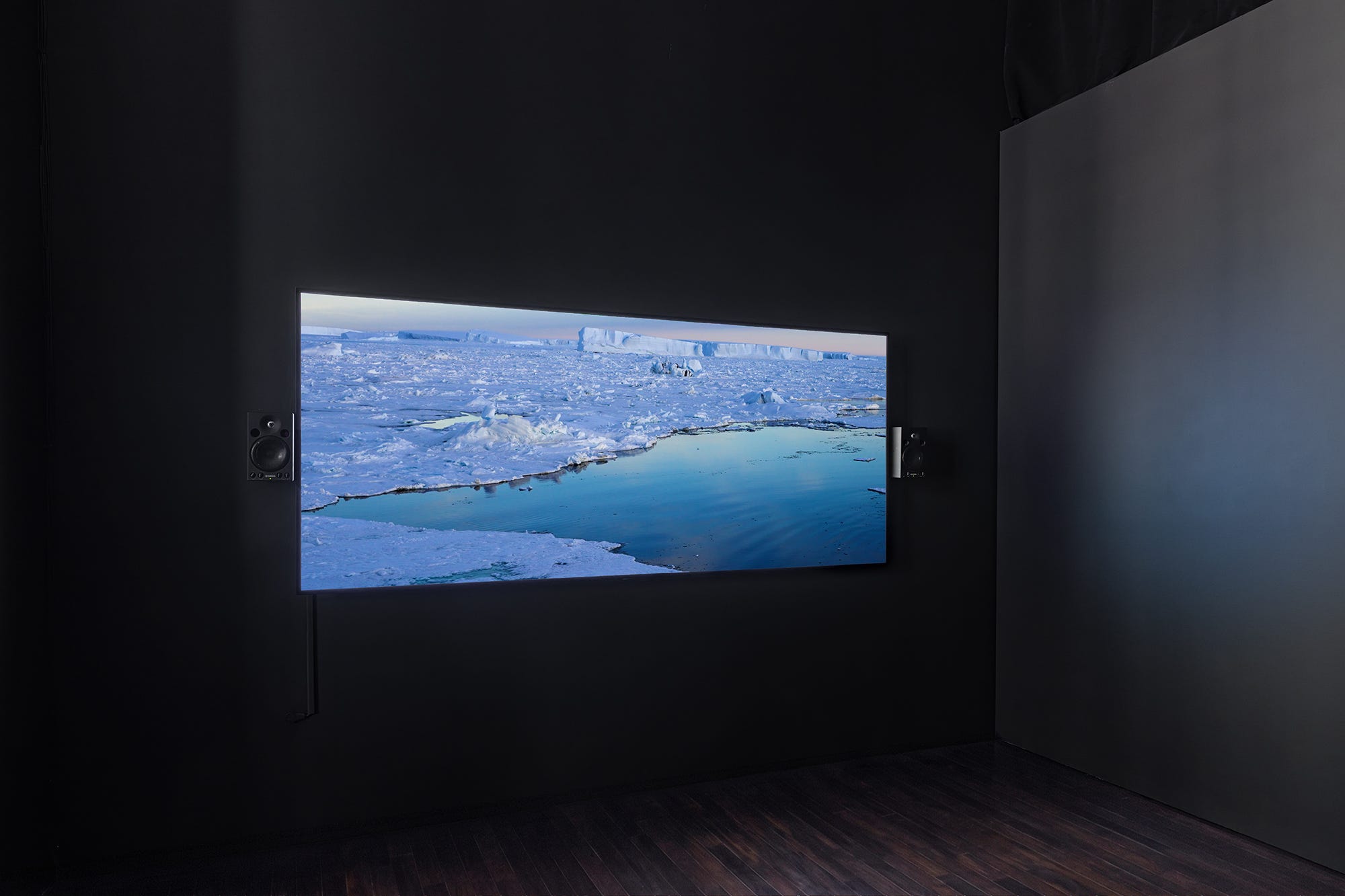
Like a poem, the work collapses time and space. Histories are collapsed by place and disparate places are collapsed into the same singular instant in time. You have this tendency to work in not just video but live medium, documentation, artifact. Not performance as much as activity that leaves a shape in the air. For the show at Cristin Tierney, I had the sensation that there was a large invisible sphere installed in the gallery space. What is the process for making something like this? Gathering the ephemera, choosing the location, making the video, editing it, adding language? Where does it begin and end and come together?
Physicists hate time. It can screw up their hypotheses and calculations. Time makes things slip, become unstable—an experiment can even change its behavior if watched. I seek out the unstable. Unstable terrain, either physical or psychological, makes me slip sideways into new thoughts and perspectives.
My process rarely follows a fixed sequence. Gathering thoughts, information, objects, and images for a project may take years, and in some cases, generations. A text I’ve written or some footage that I’ve shot for one project sometimes becomes part of another. Each project feels distinct and also part of a continuum – an endless search that will end when I do. I enter each project with intent, but often find myself in a place where I’ve lost control. The piece takes over and begins making itself. I don’t think any of my pieces are ever done. The process is ever iterative.
Your comment on “activities that leave a shape in the air” aligns with a performance that I’m currently working on to be presented as part of this exhibition. I’ve been thinking about time dilation as caused by velocity—time passing slower for someone moving relative to someone standing still—it’s reciprocal, so that each person views the other as aging slower.
I would also love to consider time dilation as caused by gravity—the amount of time elapsed depending on higher or lower gravitational forces—but the performance would need to happen at two different altitudes. Maybe a future project . . .
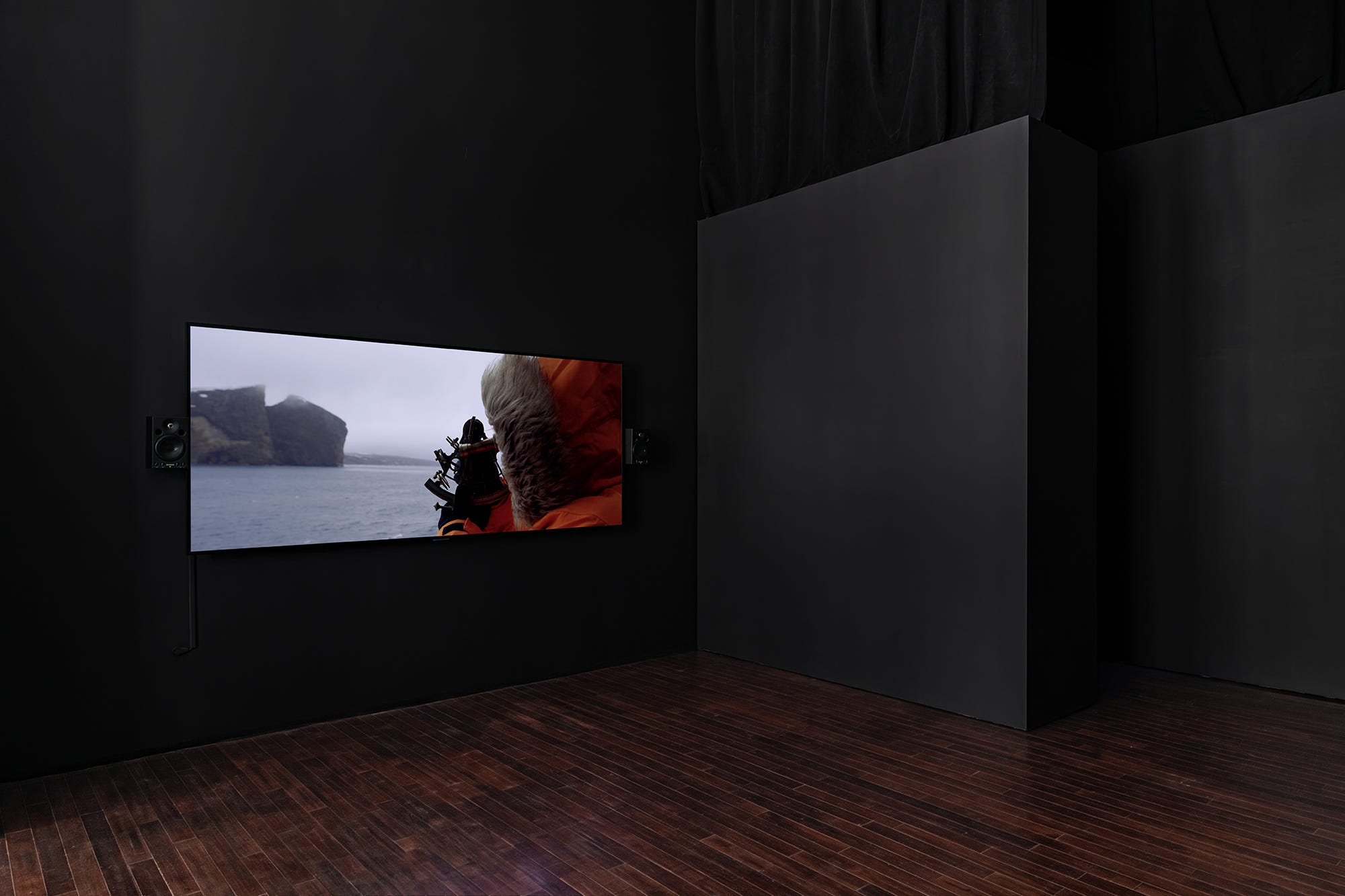
While experiencing the show it had me thinking about early human art in caves and stone carvings and it made me think: surely early humans also did things like this that we now call contemporary art? Gathered objects, sought something out in the sky or the ocean or the forest, made something brief and beautiful with it. What makes something art in your view?
It’s interesting to think about this question from a non-human centric perspective. Flora and fauna gather objects, or themselves, seeking some connection with the earth, sky, or each other. Are they making art? Is art something that is identified internally or externally?—Maybe art is simply existence.
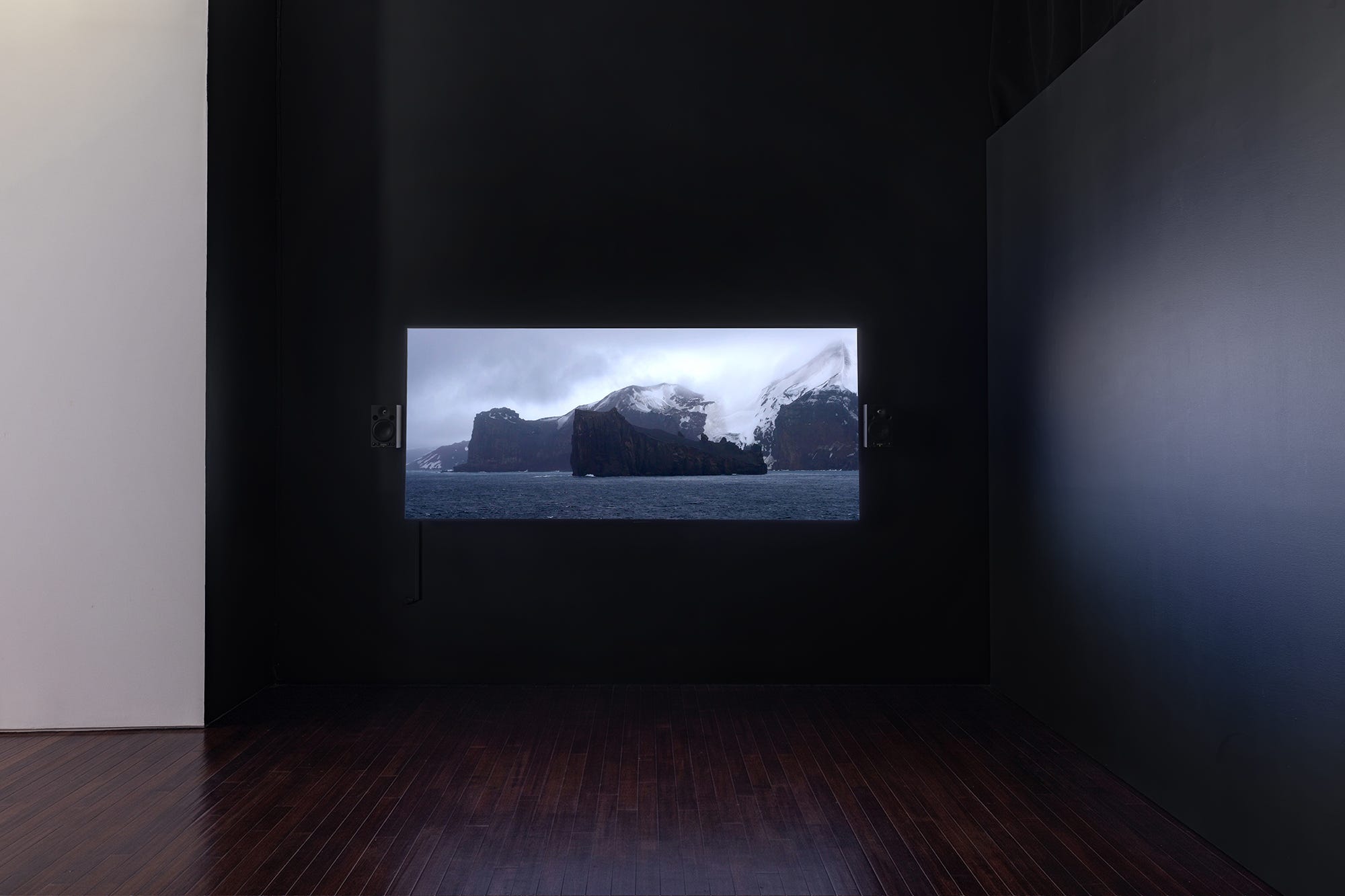
That’s an interesting thought. Especially since some animals do appear to appreciate beauty and possibly make art or can be taught to. Plants have rudimentary consciousness. I once heard someone pose a hypothesis that “consciousness isn’t inside our heads, our heads are the antennae for receiving consciousness.” Your “Maybe art is simply existence” reminds me of that. Do you experience the process of your work as receiving or creating?
My process ebbs and flows between receiving and creating. I don’t really experience them as separate processes; creating is often a way of responding to what I’ve received.
I consciously work to keep my “antennae” up and available to receive. Selecting what specific input to focus on becomes a subjective, creative act. I hold a responsibility for information that I’ve received—to honor it, to do the research, and to engage with it ethically and authentically, especially when I’m building conceptual structures informed by my personal experiences and sense of logic.
But ultimately, the work doesn’t become the work until the unexpected intercedes (back to receiving); when fog rolls in and makes viewing an eclipse impossible, when a dancer balances a leaf on his hand, when my mother loses the ability to tell day from night.
Rachel Dalamangas
New York, NY
October 2026
A new performance piece titled “Time Slip”, which Biggs made with performers Mary Esther Carter and Vinson Fraley premieres at Cristin Tierney, October 15, 6:30pm, Space is Limited